Tuesday, November 22, 2005

A Day of Israeli Cinema in Chicago
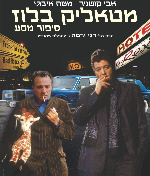


Shmuel had lost his Israeli friend in a German airport. A kind German airport employee makes an announcement over the intercom. But Shmuel’s friend, Siso, only speaks Hebrew. So Shmuel grabs the microphone from the startled employee and starts screaming Hebrew throughout the airport.

It seemed like a microcosmic example of Israeli cultural bravado, I thought as I sat in Highland Park Theater and watched a screening of Metallic Blues at a mini version of the Israeli Film Festival on Sunday, Nov. 20. It was hard to imagine an American doing that!

The festival, an all-day affair, featured screenings of seven Israeli films. Sitting in the theater waiting for the movie start, I think I heard more people talking in Hebrew than in English.

I saw Metallic Blues, a movie about two Israeli auto mechanics who buy a metallic blue, limited edition 1985 Lincoln Town Car limousine for a cheap 5,000 euros from a Palestinian who is in desperate need of cash. Upon learning that a similar car could sell for up to 50,000 in Europe, the two decide to go to Germany to try make their fortune.

Obviously, things go wrong. But it was interesting to watch Shmuel cope with being in Germany, the country responsible for the Shoah. He initially daydreams about moving to Germany with his family, where he could live with all the comforts of a booming Western economy and forget the daily violence back in Israel. Yet his initial optimism is slowly tempered as he begins hallucinating about the Germany his parents fled 60 years ago. By the end of the film, Shmuel appears to realize that Jews only have one homeland: Israel.

Aside from a humorous plot line, the film provided other insights into Israeli culture. While the characters are in Germany, there is a pigua – Hebrew for suicide bombing – in Israel. It was interesting to watch the characters frantically call home to make sure their families were all right, a routine that I knew must have become chillingly familiar for Israelis during the worst months of the Second Intifadah.

All in all, I’d say the movie was more funny than serious. And there were times during the film when the audience started bawling for apparently no reason. There must have been some inside Israeli jokes.

Next time, I’ll have to brush up on my Israeli humor before the show.

Sunday, November 13, 2005

Israel Advocacy in Madison


Shotei Ha Nevuha in concert.

I knew it was going to be a good show as soon as the eight members of Shotei Ha Nevuha, dressed in garb ranging from trendy pink button-down shirts to flowing white robes and kaffiyehs, sauntered on stage at Madison’s Club Majestic.

I was listening to the Middle Eastern reggae-funk of one of Israel’s most popular bands. I was at one of the biggest party schools in the country. And I was surrounded by hundreds of Jewish students from college campuses across the Midwest.

No, I thought, it just doesn’t get any better than this.

The concert was just one attraction of Finding Common Ground: Supporting Israel in a Time of Transition, the Israel advocacy conference that had brought my Jewish comrades and I to Madison.

The weekend affair, which ran from Friday, Nov. 4 through Sunday, Nov. 6, 2005, drew participants by combining scintillating speakers and discussion panels about Israeli politics with the mystical allure that Madison has for fun-seeking college students everywhere. It was all for only $25, or $60 if you wanted to stay in a hotel for the two nights.

Learn about Israel by day, party by night. Who could say no?

Yet perhaps the most interesting thing for me, a junior at Northwestern University who has only been tangibly involved in Israel campus advocacy events like this, was meeting up with people I hadn’t seen in years.

It happened as soon as I sat down for dinner Friday night at Madison’s Hillel.

“Were you in BBYO?”

And then again, as we trickled out of Club Majestic.

“My long-lost Schechter friend!”

But Madison provided me with a frustrating quandary. Still under 21, I had to hunt for parties outside the bars. So, the adventure began.

“Do you know if anything is happening tonight?” I asked a group of girls who were milling around Club Majestic.

“Well,” one of them said haltingly, “my friend is having a dance party…”

I took the hint.

“But some random guy who you just met on the street isn’t really invited.”

“I mean, I guess you could come…”

Eventually, I went with some people attending the conference to a birthday party. It was for one of their Jewish friends who went to Madison. At some points, my conference buddies left, and I stuck around.

At some point, somebody asked me: “So Mike, who do you know here?”

“Well, nobody right now…”

But it was okay. We shared a common bond: We were all Jews.

Social life aside, the conference did offer some interesting viewpoints about the most recent developments in Israel. The keynote speaker was Yossi Klein Halevi, a writer for the New Republic and columnist for the Jerusalem Post.

Ten years after Israeli Prime Minister Yitzhak Rabin was assassinated by a Jewish extremist as a result of Rabin’s peace overtures, Halevi spoke about the relationship between Disengagement and Rabin’s policies.

The past three decades have witnessed the death of two utopian dreams – on both the Israeli left and right, Halevi said. The failure of Oslo, especially after Camp David and the second intifadah, saw the end of the leftist utopia – a full and equal peace with the Palestinians and the Arab world. But the Disengagement also shows that the Israeli right has recognized that Israel cannot rule over a fast-growing Palestinian population indefinitely if the country wants to maintain its Jewish majority. It is the end of the dream of Greater Israel.

The Israeli public has sobered up, Halevi said, and has moved to the center. Israelis are ready to make painful territorial concessions, but only to a Palestinian Authority free of terrorism. In the meantime, Halevi said, unilateralism has won the day.

Azanu Mekunen, an Ethiopian immigrant to Israel, also spoke about her experiences traveling from Africa to the Holy Land. In addition, there were also mini-presentations about spreading pro-Israel message on campuses, Israel’s relationship with the U.N., Muslim-Jewish dialogue on campus, and more.

Not bad for 25 bucks.